Agent’s Last Exam: Why Benchmarks Don’t Mean Job-Ready
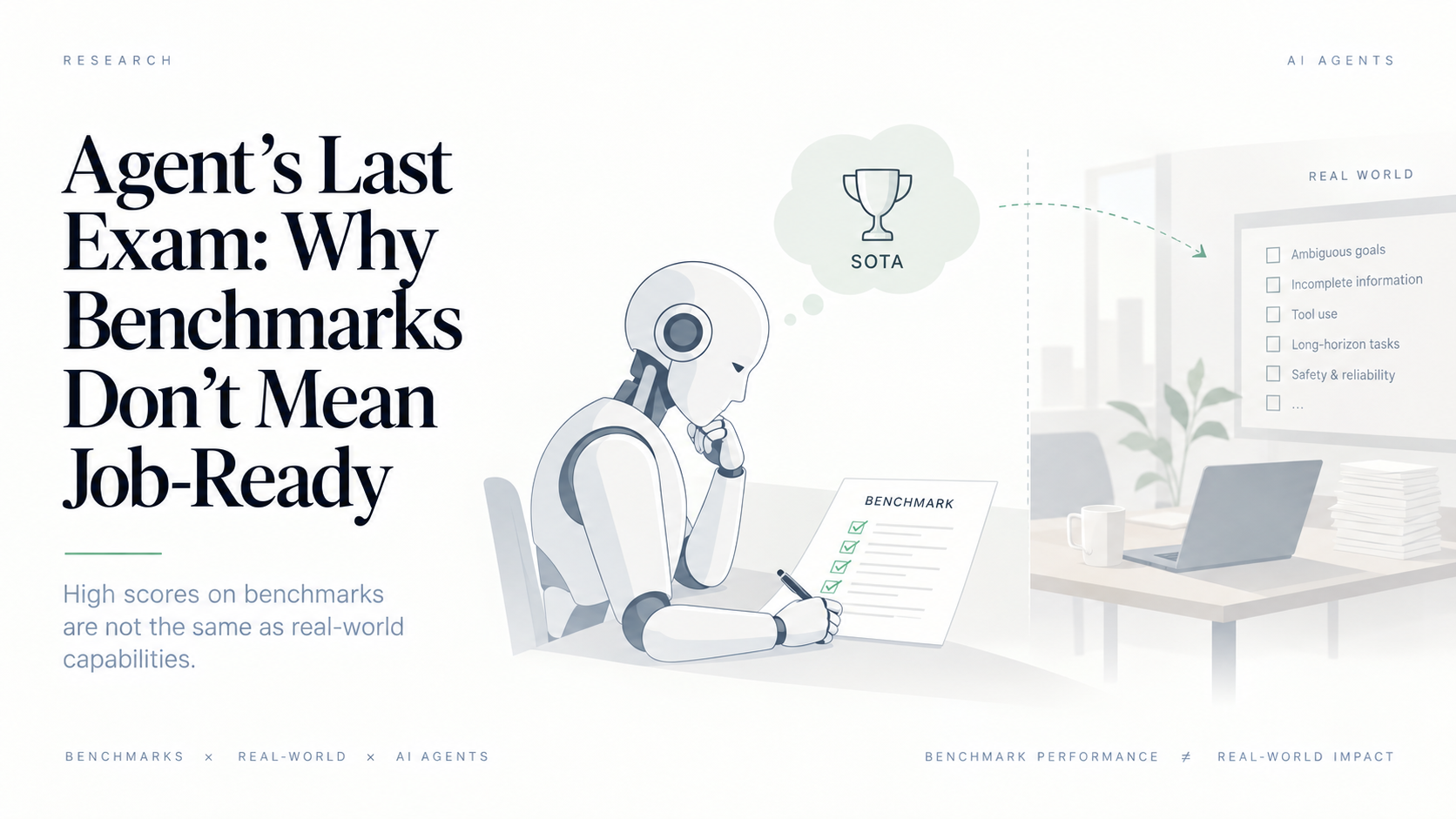
AI agents increasingly solve coding exercises, browse websites, manipulate files, and operate desktop interfaces. Yet strong benchmark results still rarely translate into reliable execution of economically meaningful professional work. The gap is not only a model problem. It is also an evaluation problem: many benchmarks measure isolated knowledge, short interactions, or narrow tool use, while real work combines domain expertise, planning, software operation, verification, and recovery from mistakes over long time horizons.
The preprint Agents’ Last Exam proposes a benchmark built around that gap. Instead of asking whether an agent can answer a difficult question or complete a few interface actions, it evaluates whether the system can produce a verifiable professional deliverable inside a real computer environment. The result is a demanding test of current agentic systems—and a useful case study in how AI evaluation must change if it is to inform deployment.
The central question is no longer simply whether an AI system possesses the required knowledge. It is whether the system can transform that knowledge into a correct, complete, and verifiable result across an entire workflow.
Why existing benchmarks capture only part of the problem
A benchmark is an engineering target. Once a capability is represented by a stable dataset, a clear metric, and a reproducible evaluation loop, researchers can optimize against it. This mechanism helped accelerate progress in image recognition, question answering, code generation, and computer use.
But the choice of task unit matters. A multiple-choice question can reveal whether a model recognizes the correct answer. A browser benchmark can show whether an agent can navigate a website. A coding benchmark can verify whether a patch passes unit tests. None of these results, taken alone, establishes that the system can complete a project that a professional would normally perform over several hours or days.
| Evaluation family | What it measures well | What is usually missing |
|---|---|---|
| Knowledge and exam-style QA | Factual knowledge, scientific reasoning, short-form problem solving | Interaction with software, persistent execution, artifact production |
| GUI or web benchmarks | Visual grounding, navigation, short sequences of interface actions | Deep domain knowledge, code execution, long-horizon project structure |
| CLI and coding benchmarks | Shell use, repository modification, executable verification | Graphical software, heterogeneous deliverables, non-software professions |
| Economically grounded project benchmarks | Realistic deliverables and professional relevance | Often broad automated verification, affordable repeated evaluation, or full domain coverage |
Agents’ Last Exam, abbreviated ALE, attempts to combine four properties that are difficult to obtain simultaneously: authentic work, long task horizons, broad professional coverage, and automatic verification.
How ALE turns professional work into an executable benchmark
The benchmark is anchored in the US Standard Occupational Classification and O*NET taxonomies. Occupations with similar software-mediated workflows are grouped into 13 clusters and 55 subdomains. Physical work is excluded when its core outcome cannot be meaningfully reproduced in a digital environment.
Tasks are not written as generic simulations by benchmark designers. Domain experts contribute projects based on work they have already completed. A proposal must specify the request, input files, target software, expected deliverable, and evaluation criteria. It then passes through expert review, engineering implementation, dry runs, and final quality control.
Three admission criteria
Representativeness
The workflow should resemble professional practice and use the software a practitioner would normally choose.
Complexity
The task must be an end-to-end deliverable rather than a single local action or interface operation.
Verifiability
The final artifact must support deterministic checks or a sufficiently explicit, evidence-grounded rubric.
This distinction between an action and a workflow is essential. Applying a filter in video-editing software is an action. Moving a subject from one video into another while preserving tracking, compositing, and visual coherence is a coupled workflow. The latter tests whether an agent can coordinate several dependent operations and preserve a global objective.
Only about 10% of the collected task pool is public. The remaining instances are held back and can be rotated into future evaluations. This design reduces contamination from training data and task-specific optimization, although it also makes independent analysis of the full benchmark more difficult.
The evaluation pipeline: task, agent, environment, artifact
Each benchmark instance separates three components: an executable task specification, the agent under evaluation, and a remote virtual-machine environment. This decoupling is important because it allows different models and orchestration systems to be tested against the same task logic.
The task declares its description, assets, required software, compute needs, and evaluator.
A virtual machine is initialized with read-only inputs, installed tools, and a writable output directory.
The agent observes screenshots and files, calls tools, writes code, uses applications, and iterates.
The produced files or system state are compared with hidden references and structured criteria.
The task specification exposes three lifecycle functions: load(), start(), and evaluate(). The agent sees the task description and available environment, but not the reference artifacts used for scoring. Its writable target is an output directory, which makes the final deliverable the central object of evaluation.
Why full-pass rate and mean score are both necessary
ALE reports a fine-grained mean score and a full-pass rate. The distinction matters because a partially correct report, spreadsheet, 3D model, or software artifact may receive some credit while still being unusable as a completed professional deliverable.
Here, \(N\) is the number of evaluated task instances, \(S_j \in [0,1]\) is the score of instance \(j\), and \(\mathbb{1}[S_j=1]\) equals one only when the task receives full credit. An agent can therefore achieve a non-zero average score while completing none of the tasks end to end.
Gate-and-score evaluation
Many professional artifacts have hard validity constraints. A manufacturing toolpath that resembles the reference but produces a collision is not partially acceptable. A workbook that cannot be opened is not useful even if some underlying values are correct. ALE frequently handles this with a gate followed by a graded score.
In this general form, \(G(x)\in\{0,1\}\) represents a mandatory validity condition, \(s_i(x)\) are partial quality measures, and \(w_i\) are their weights. When the gate fails, the entire score becomes zero. This makes the evaluator stricter than a metric that rewards superficial similarity while ignoring a critical defect.
The benchmark uses several artifact-specific modes: exact or hashed values, numeric fields with tolerances, geometric distances, executable tests, behavioral state checks, and structured rubrics. According to the paper’s static analysis of the open task tree, 93.2% of workflows use code-based judges. The remaining 6.8% use language or vision models for outputs that are difficult to reduce to deterministic signals, such as rendered scenes or visual media.
When a model judge is unavoidable, ALE uses narrow yes/no questions tied to visible evidence rather than a single holistic request to “rate the quality” of an artifact. This reduces—but does not eliminate—judge instability and subjectivity.
What kind of agent is actually being tested?
The benchmark targets what the authors call a Generalist Computer-Use Agent. This is broader than a GUI agent. Real workflows may require visual interaction with desktop applications, shell commands, file operations, code execution, API calls, web research, and context management within the same trajectory.
Brain
Reasoning, planning, decomposition, and domain-level decisions.
Eyes
Perception of screenshots, interfaces, diagrams, and visual feedback.
Body
Orchestration of the action loop, state, delegation, and control flow.
Hands
Structured access to files, shells, browsers, APIs, and desktop actions.
Feet
The runtime substrate in which commands execute and artifacts are produced.
CLI-native agents usually have strong access to files, code, and runtime tools but no native visual perception. GUI agents can see and click, but often have limited file manipulation, programming, or long-horizon orchestration. ALE extends tested systems with a common GUI-as-tool bridge so that one model can reason over both terminal output and visual feedback.
This setup also separates the foundation model from the agent harness. The model supplies reasoning and generation; the harness manages prompts, tools, sub-agents, context compaction, and execution. Evaluating both components matters because a capable model can fail inside a weak control loop, while a sophisticated harness cannot fully compensate for missing domain knowledge.
Current agents make progress, but rarely finish the hardest workflows
The public evaluation is divided into three tiers. Near-Term contains tasks that frontier systems can already complete in meaningful numbers. Full-Spectrum ensures coverage across all 55 subdomains. Last-Exam contains the hardest workflows and is intended to preserve long-term headroom.
| Agent configuration | Near-Term pass | Full-Spectrum pass | Last-Exam pass | Overall pass |
|---|---|---|---|---|
| Codex + GPT-5.5 | 38.1% | 22.7% | 0.0% | 24.0% |
| ALE-Claw + GPT-5.5 | 32.8% | 23.6% | 2.6% | 23.0% |
| Claude Code + Fable 5 | 34.3% | 20.9% | 0.0% | 22.0% |
| Cursor + GPT-5.5 | 32.1% | 20.0% | 2.6% | 20.7% |
| Gemini CLI + Gemini 3.1 Pro | 26.9% | 12.7% | 0.0% | 15.8% |
These results support two conclusions of different strength. First, the observed result is clear: current systems can make substantial partial progress and fully complete a minority of easier professional workflows, but the hardest tier remains almost entirely unsolved. Across the tested configurations, the average full-pass rate on Last-Exam is below 1%.
Second, the broader interpretation is more cautious. The benchmark suggests that success on coding, knowledge, or short computer-use tests overestimates readiness for heterogeneous professional projects. It does not prove that ALE performance directly predicts economic productivity, organizational adoption, or job displacement.
A useful comparison is the Linux-only ALE-CLI subset. The strongest reported Codex configuration reaches 82% on Terminal-Bench but only 23.3% overall on ALE-CLI, with 0% full passes on the hardest CLI tier. The difference suggests that task duration, professional specificity, and deliverable structure matter even when the interaction surface remains largely terminal-based.
The most revealing result is the failure pattern
A low score alone does not explain what capability is missing. ALE therefore analyses tool traces and classifies failures for one Claude Code and Claude Opus configuration.
Roughly three quarters of classified failures arise from misunderstanding the domain or choosing an unsuitable strategy, rather than from a local execution error alone.
Graphical software is the designated primary tool for 34% of public instances, yet agents often replace it with improvised scripts or command-line shortcuts.
Among well-engineered systems, the paper estimates that model choice creates about three times more performance spread than harness choice.
The first result is particularly important. Tool access is not equivalent to tool competence. Giving an agent a shell, a browser, a graphical interface, and a large context window does not guarantee that it knows which professional method to apply, which software representation matters, or which intermediate checks prevent an invalid final artifact.
The underuse of graphical applications illustrates this problem. A script may be easier for an agent to generate than a sequence of precise operations in specialist software. But replacing the intended workflow can discard hidden constraints encoded by that software: geometry, project state, metadata, simulation behavior, or domain-specific validation.
The resource analysis also weakens a common assumption: longer trajectories, more tokens, and higher API cost do not reliably produce better results. Additional computation helps only when the agent can preserve a correct plan, interpret feedback, and revise its approach.
What the benchmark does not establish
Its contribution is substantial, but several limits should constrain how its results are interpreted.
Automatic verification still encodes design choices
Deterministic evaluation is more reproducible than open-ended human grading, but every evaluator defines what counts as success. Thresholds, hidden references, gates, and rubric weights may privilege one acceptable solution path over another. Quality control reduces this risk; it cannot remove it completely.
The public subset is limited
The public tasks represent only about one tenth of the full pool. The authors report a strong domain-level correlation between public and private performance for one tested configuration, with Pearson \(r=0.89\). This supports representativeness, but it does not guarantee that every future model or agent architecture will preserve the same relationship.
Repeated evaluation is expensive
A single frontier-agent run costs roughly $3–10 on average and can take tens of minutes to hours. Runs are capped at five hours, and only a subset of configurations is repeated three times. Consequently, some reported differences may include stochastic variation that has not been measured uniformly.
A virtual machine is not an organization
ALE captures long computer workflows more faithfully than short-form benchmarks, but real deployment also involves ambiguous goals, changing requirements, collaboration, permissions, accountability, confidential data, interruptions, and feedback from stakeholders. These factors are only partially represented by an isolated benchmark instance.
Economic relevance is a hypothesis, not a measured outcome
The tasks are economically meaningful by construction, but the benchmark does not measure productivity gains, return on investment, error liability, or adoption in live organizations. Saturating ALE could be evidence of stronger professional capability; it would not automatically demonstrate safe or profitable deployment.
Implications for building and evaluating production agents
Evaluate workflows, not demonstrations
A polished single interaction says little about whether the system can preserve correctness across a complete process.
Score artifacts and hard constraints
Production evaluations should inspect files, states, tests, tolerances, and invalidating conditions—not only the final natural-language response.
Measure partial progress separately
Fine-grained scores help diagnose improvement, while full-pass metrics reveal whether the output is actually complete.
Test domain strategy
Access to tools should be paired with checks that the agent selects appropriate methods and specialist software.
Track cost, time, and variance
A system that occasionally succeeds after hours of expensive execution may still be unsuitable for production.
Separate model and harness effects
Evaluation should vary the foundation model and orchestration layer independently to identify the true bottleneck.
Conclusion
Agents’ Last Exam reframes agent evaluation around a practical question: can an AI system complete the kind of software-mediated workflow that produces a real professional deliverable? Its answer, for current systems, is mixed. Frontier agents can solve a meaningful subset of near-term tasks and make partial progress on many others, but they almost never fully complete the hardest workflows.
The mechanism behind this gap is not simply a lack of mouse clicks, shell commands, or context length. The failure analysis points toward domain understanding, strategy selection, and correct use of specialist tools. The benchmark’s most important contribution may therefore be methodological: it makes the artifact, the workflow, and the evaluator—not the model’s final sentence—the unit of analysis.
The remaining open question is whether benchmarks of this kind can stay uncontaminated, affordable, and representative as agent capabilities improve. Answering it will be essential if evaluation is to become a reliable bridge between impressive demonstrations and dependable AI systems in production.
Sources
- Yiyou Sun et al., “Agents’ Last Exam” , arXiv:2606.05405v2, submitted in June 2026. Preprint; not presented here as peer-reviewed work.
- Agents’ Last Exam project website .
- ALE code and public benchmark resources .