
When Vision Speaks for Sound
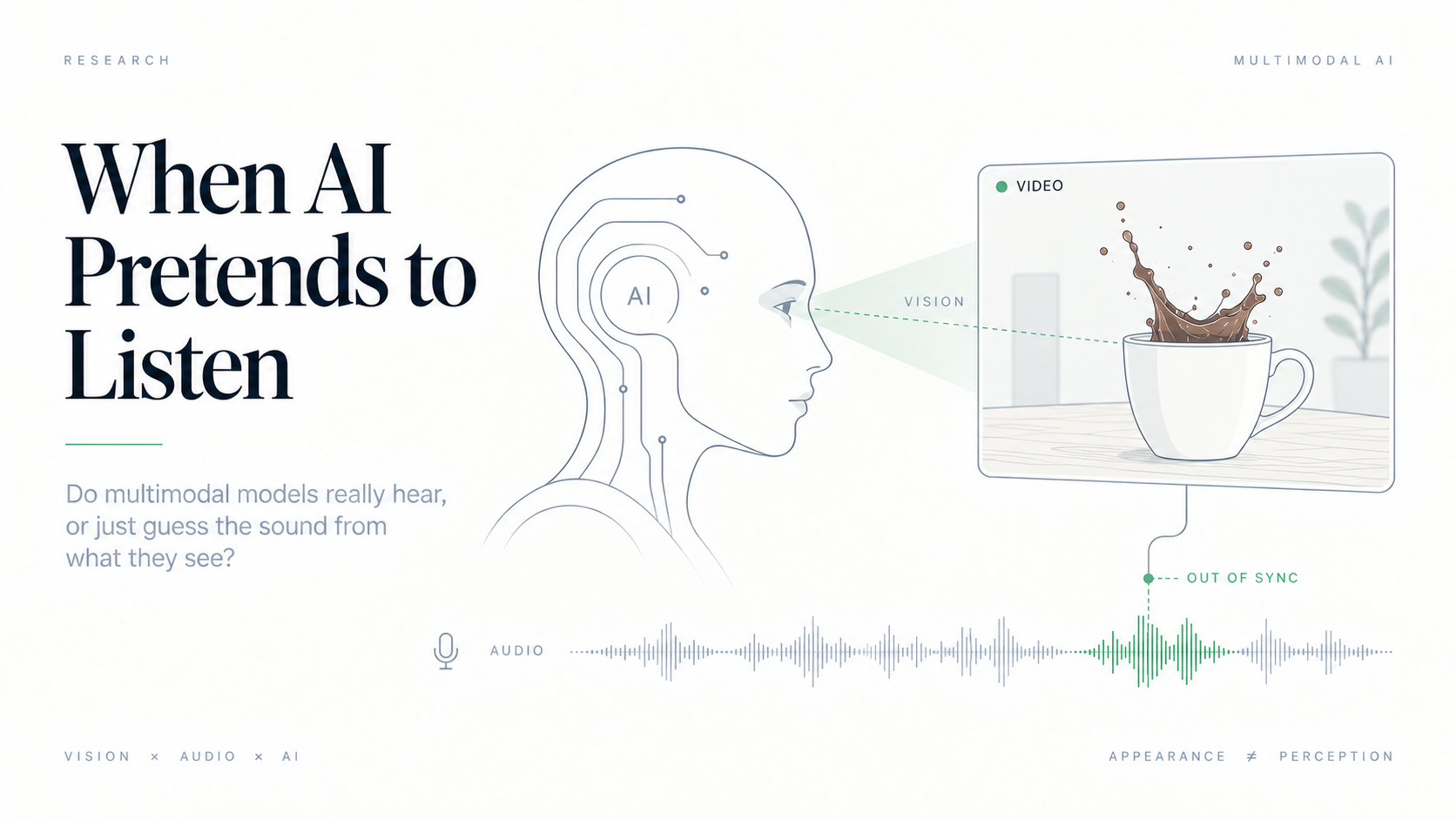
Modern multimodal models can describe videos, answer questions about them, and reason over visual and audio streams. But do they really listen? Or do they merely infer what the sound should be from what they see?
This article discusses the paper When Vision Speaks for Sound , which investigates a hidden failure mode in audio-visual language models.
The illusion of multimodal understanding
Audio-visual models are often evaluated on natural videos: a dog barking, a glass breaking, a person speaking, a car passing by. In these settings, vision and sound are usually aligned. The image strongly suggests what the audio should contain.
This makes evaluation deceptively comfortable. A model can appear to understand both modalities while relying mostly on the visual stream. If it sees a drummer hitting a cymbal, it may answer that there is a crashing metallic sound. But this does not prove that the model actually processed the audio. It may simply have learned the regularities of the world.
The model may not be listening. It may be guessing the sound that usually belongs to the image.
This is the central issue studied in When Vision Speaks for Sound. The authors show that several state-of-the-art audio-visual language models display a form of multimodal shortcut learning: they infer sound from vision, even when the audio is missing, shifted, or replaced.
A Clever Hans effect for video models
The paper frames this behavior as an audio-visual version of the Clever Hans effect. Clever Hans was a horse that seemed capable of arithmetic, but was actually responding to subtle human cues. The performance was real in appearance, but the underlying mechanism was not the one people believed.
The analogy is useful. Audio-visual models may seem to answer questions about sound, synchronization, or event timing. Yet in many cases, they are exploiting visual cues that correlate with the expected audio.
This distinction matters. In production systems, the difference between predicting what is likely and verifying what is present is not cosmetic. It is the difference between a useful multimodal system and a brittle one.
Breaking correlations with counterfactual videos
To reveal this failure mode, the authors introduce a benchmark named Thud. Its goal is simple: break the natural correlation between image and sound, then observe whether the model still answers as if everything were normal.
The benchmark relies on three interventions:
| Intervention | Modification | Question tested |
|---|---|---|
| Mute | The audio is removed. | Can the model detect silence, or does it hallucinate expected sounds? |
| Swap | The audio is replaced with audio from another video. | Can the model identify audio-visual inconsistency? |
| Shift | The audio is temporally shifted. | Can the model reason about synchronization? |
These interventions are powerful because they do not require exotic scenarios. They take ordinary videos and alter the relationship between modalities. If a model truly understands the audio-visual scene, it should notice the manipulation. If it relies on visual priors, it will continue to describe the sound that the image suggests.
What the models actually do
The results are striking. Across several models, performance drops sharply when the natural relationship between vision and sound is disrupted. Models that perform well on original videos can fail almost completely when the audio is shifted, muted, or swapped.
The most revealing errors are not random. They are semantically plausible. On muted videos, models often describe sounds that would normally occur in the scene. On swapped videos, they may ignore the actual audio and answer according to the visual content. On shifted videos, some models exhibit a strong bias toward assuming that the audio and image are synchronized.
This suggests that the models have learned useful world regularities, but not always the discipline of checking the sensory evidence. They know what a scene should sound like. They are much less reliable at verifying whether it actually sounds that way.
This is a particularly important failure mode because it can look like intelligence. A visually plausible answer may be fluent, confident, and even correct in ordinary cases. But when the environment changes slightly, the same mechanism becomes a source of hallucination.
From evaluation to alignment
The paper does not stop at diagnosis. The authors also show that counterfactual data can be used to improve model behavior.
They construct preference data where a desirable answer explicitly checks the audio-visual evidence, while an undesirable answer follows the visual shortcut. They then use a two-stage alignment procedure: supervised fine-tuning followed by preference optimization.
The important point is not merely the training recipe. The broader lesson is that robust multimodal models need training signals that reward verification, not only plausible completion. If the benchmark always contains natural correlations, the model has little incentive to learn the harder behavior.
Why this matters for real-world AI systems
This paper is not only about audio. It exposes a general problem in multimodal AI: models often exploit whichever modality gives the easiest shortcut.
In a video setting, the shortcut may be visual. In a document intelligence system, it may be layout. In a claims-processing workflow, it may be a recurring template. In a multi-agent system, it may be a repeated textual pattern that looks authoritative but has not been verified against the source.
For production AI, this has direct consequences. Systems must not only produce plausible answers. They must be able to explain which evidence they used, detect missing or conflicting information, and remain robust when correlations break.
The paper therefore reinforces a central design principle for reliable AI systems:
Multimodal intelligence should not be measured only by how well a model completes the world. It should be measured by how carefully it checks the world.
A useful direction for multimodal evaluation
The strength of When Vision Speaks for Sound is that it turns a vague concern into a concrete evaluation protocol. Instead of asking whether a model performs well on natural videos, it asks whether the model still behaves correctly when the usual correlations are broken.
This counterfactual mindset is likely to become increasingly important. As multimodal systems move from demos to operational workflows, standard benchmarks are not enough. We need tests that expose shortcut learning, hallucinated evidence, and overreliance on dominant modalities.
In that sense, the paper is a useful reminder: the next generation of AI systems will not only need stronger models. It will need better ways to verify that these models are using the right evidence for the right reason.
Conclusion
When Vision Speaks for Sound shows that audio-visual language models can appear to listen while relying heavily on vision. By muting, swapping, and shifting audio tracks, the authors reveal a robust Clever Hans effect in current multimodal systems.
The lesson extends beyond audio-visual modeling. Reliable AI systems must be evaluated under counterfactual conditions that break easy correlations. Otherwise, we risk deploying models that are fluent, impressive, and wrong for exactly the reason they seemed intelligent.
For teams building multimodal or agentic AI systems, the message is clear: do not only ask whether the model gives the right answer. Ask whether it used the right evidence.