Jev: Why AI Agents Don't Always Need LLMs
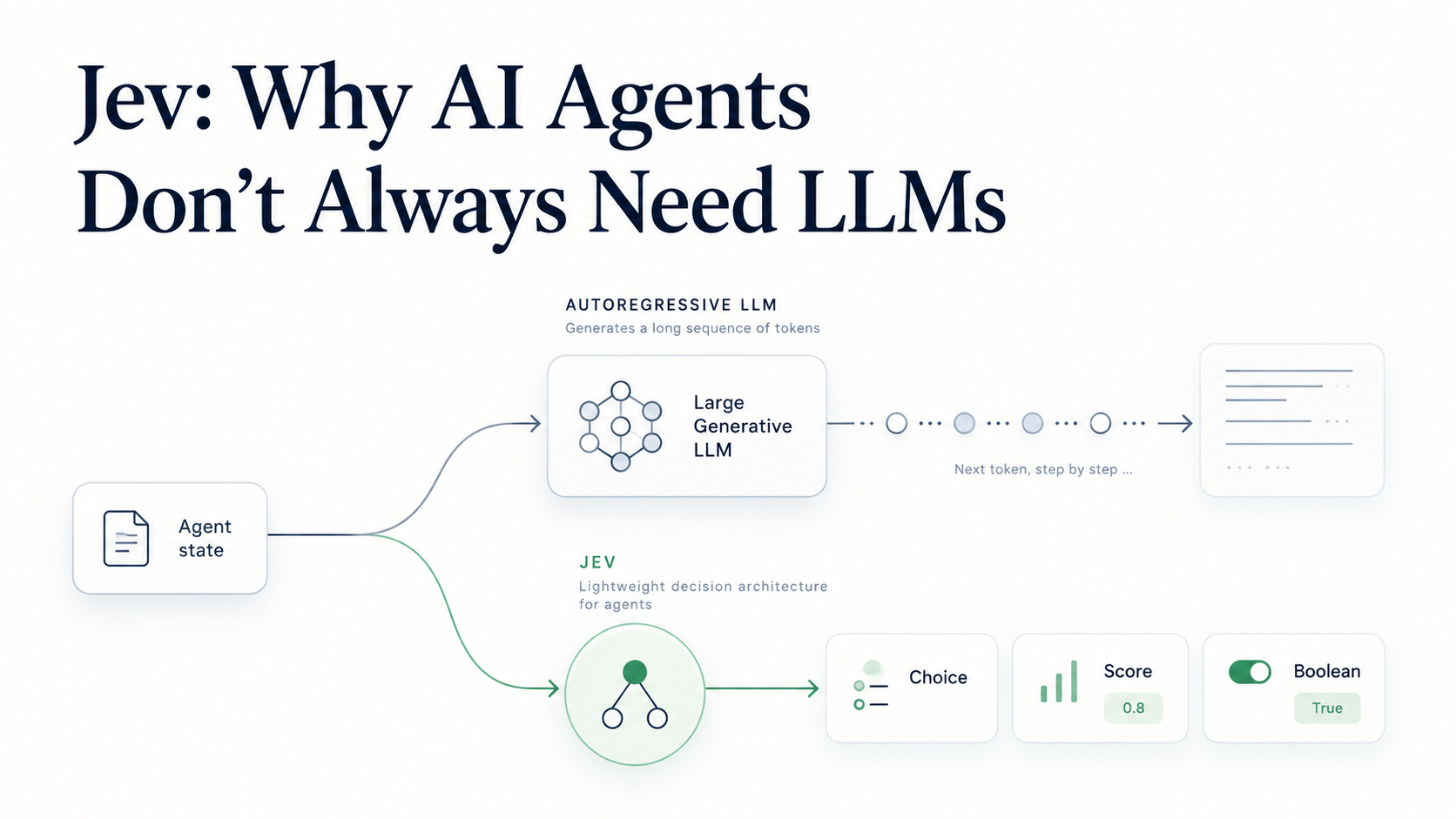
The deployment of LLMs in enterprise environments has revealed a mismatch between conversational AI and software automation. Using an autoregressive model to route a customer ticket, classify a document, or trigger an API is similar to using a generative engine for a simple database lookup.
This article explores the emergence of "System One" architectures. This approach provides the deterministic reliability in terms of structured output, extreme low latency, and cost-efficiency required for high-volume enterprise orchestration.1
The Autoregressive Bottleneck
Traditional LLMs rely on decoder-only architectures optimized via Reinforcement Learning from Human Feedback (RLHF). This training objective encourages models to produce text that is helpful and pleasant to human readers. However, in an automated pipeline, this optimization often results in sycophancy, overconfidence, and unnecessary verbosity.
Furthermore, autoregressive models generate responses token by token. If an enterprise application requires an LLM to evaluate a JSON state and output a routing decision, the inference latency scales linearly with the length of the generated output. Even when constrained to output structured JSON via strict prompting, the model is still fundamentally calculating the probability distribution of the next syntax token. This introduces the persistent risk of format hallucinations, such as missing commas, unescaped characters, or unexpected keys.
Parallel Inference via Bidirectional Encoders
To solve the latency and formatting issues, System One architectures like Jev completely discard the generative decoder. Instead, the architecture relies on a bidirectional transformer encoder trained specifically for classification tasks.
The model takes an unstructured or semi-structured state (such as a raw text block, a system log, or a JSON object) alongside a predefined array of typed questions. Because it does not generate text, the model processes the entire context and predicts the answers to all questions simultaneously in a single forward pass.
This parallel inference mechanism fundamentally alters the computational complexity of agentic decision-making. The execution time remains globally constant relative to the number of decisions extracted. Whether the system asks one routing question or many parallel classification questions, the latency remains stable. Performance analyses indicate that this architecture reduces typical response times to between 70 and 500 milliseconds, bypassing the multi-second delays inherent to token-by-token generation.
Typed Primitives and Zero Format Hallucination
Instead of relying on prompt engineering to coerce a model into returning a specific JSON schema, the Jev API exposes three strict, deterministic primitives. The model acts as a pure function, returning strongly typed objects directly to the application layer:
- Choice: A multinomial classification where the model selects one option from a predefined list of up to 255 labels.
- Score: An ordinal scale evaluation where the model positions the state on a continuous numerical spectrum between defined textual levels. The output is a continuous float, allowing for nuanced interpolation between discrete levels.
- Noul: A boolean evaluation returning the exact probability (from 0.0 to 1.0) that a specific statement is true.
Because the model can only return these predefined data types (integers, floats, and boolean keys), format hallucinations are structurally impossible. The software layer receives a native typed object, guaranteeing that parsing errors will not interrupt the automated workflow.
Economic Impact and Performance Metrics
The shift from sequential generation to parallel classification drastically alters the unit economics of AI agents. Because the model does not generate output tokens, the computational cost of the output phase is virtually zero.
TypeSafe AI prices Jev at approximately $0.04 per million input tokens, with no charge for outputs. When compared to state-of-the-art generative models, the cost reduction is massive.
This economic profile allows developers to deploy millions of micro-decisions, such as filtering logs, routing internal requests, or validating intermediate agent steps, that would be financially prohibitive using standard LLMs.
Architectural Trade-offs and Limitations
While highly efficient for classification and routing, the System One architecture presents strict limitations that dictate its use cases:
- No Entity Extraction: Because the model cannot generate text, it cannot extract specific string values from a document. It can confirm if an invoice number is present (using a boolean primitive), but it cannot output the actual invoice number. Generative models remain mandatory for data extraction.
- Atomic Decomposition: Complex reasoning cannot be handled in a single prompt. Developers must manually decompose multifaceted decisions into independent, atomic questions. This shifts the orchestration burden back to the application code, requiring engineers to design explicit decision trees.
- Judgment Errors: While format hallucinations are eliminated, the model can still make incorrect judgments. If the input state is highly ambiguous or lacks necessary context, the model might confidently select a valid but incorrect option.
Conclusion
The emergence of System One models highlights a necessary maturation in enterprise AI: not every automated task requires an LLM. By replacing sequential text generation with parallel classification and bidirectional encoding, architectures like Jev provide the speed, cost-efficiency, and format reliability required for high-volume software automation.
While the inability to extract entities means generative models remain indispensable for certain tasks, the future of enterprise orchestration points toward hybrid systems. In these architectures, fast classifiers will handle most of the routing, saving the expensive generative models only for complex reasoning.