Deep Agents: How Agent Harnesses Scale AI Agents
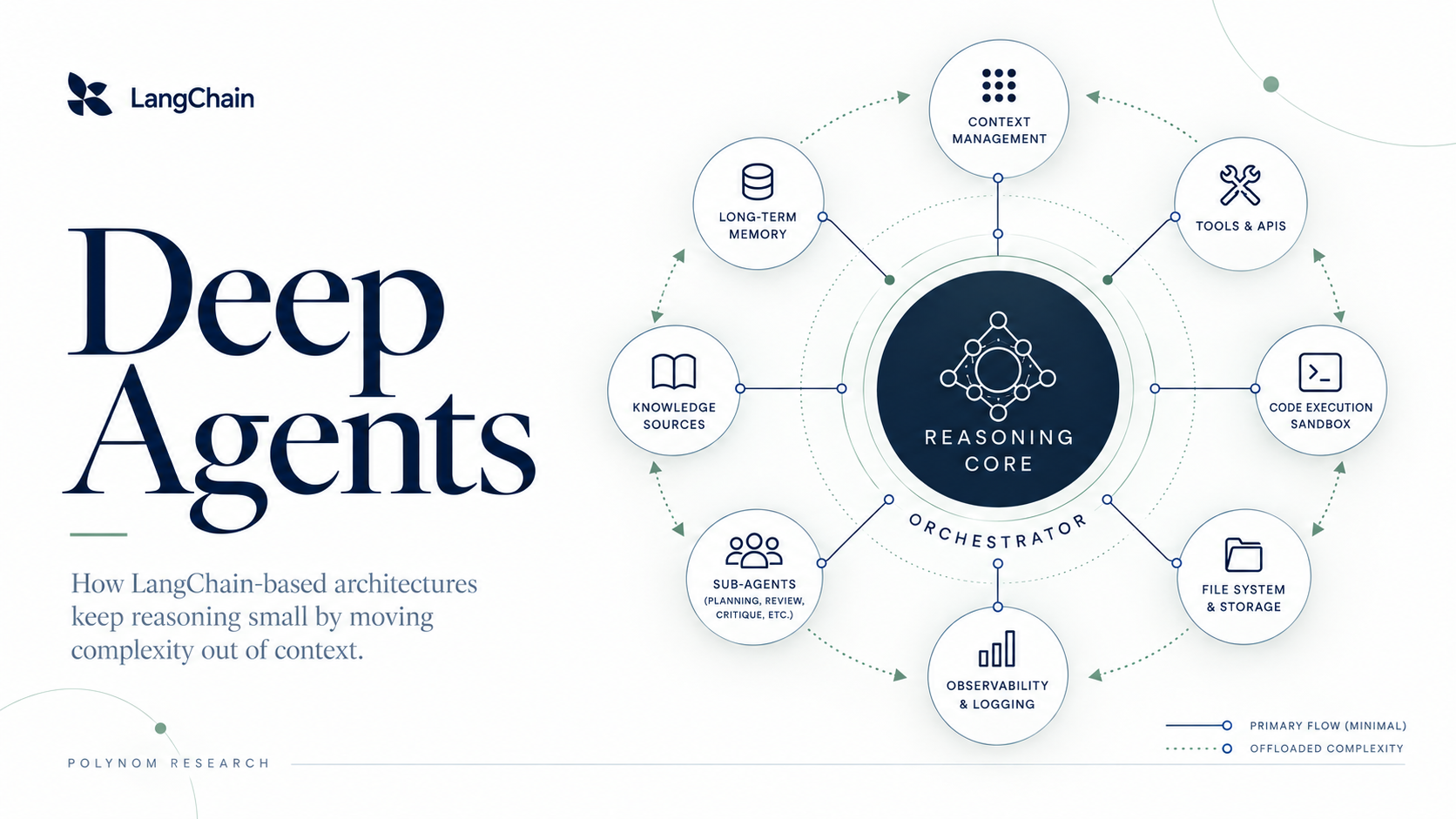
Based on the Deep Agents framework by LangChain.
Scaling Large Language Models (LLMs) from reactive chatbots to autonomous enterprise systems exposes an architectural limitation: context saturation. Early agent implementations relied on a shallow tool-calling loop. As these agents interact with external enterprise databases or APIs, they ingest massive, unfiltered data directly into their prompt. This rapid accumulation saturates the context window, inflates inference costs, and severely degrades the model's selective attention.
This article explores how LangChain's Deep Agents framework addresses this cognitive bottleneck. By implementing a strictly structured middleware stack, acting as an agent harness, on top of LangGraph, it introduces context isolation, virtual file systems, and progressive disclosure to keep the primary agent focused on long-term planning without losing technical reliability.
The Architectural Bottleneck of Shallow Agents
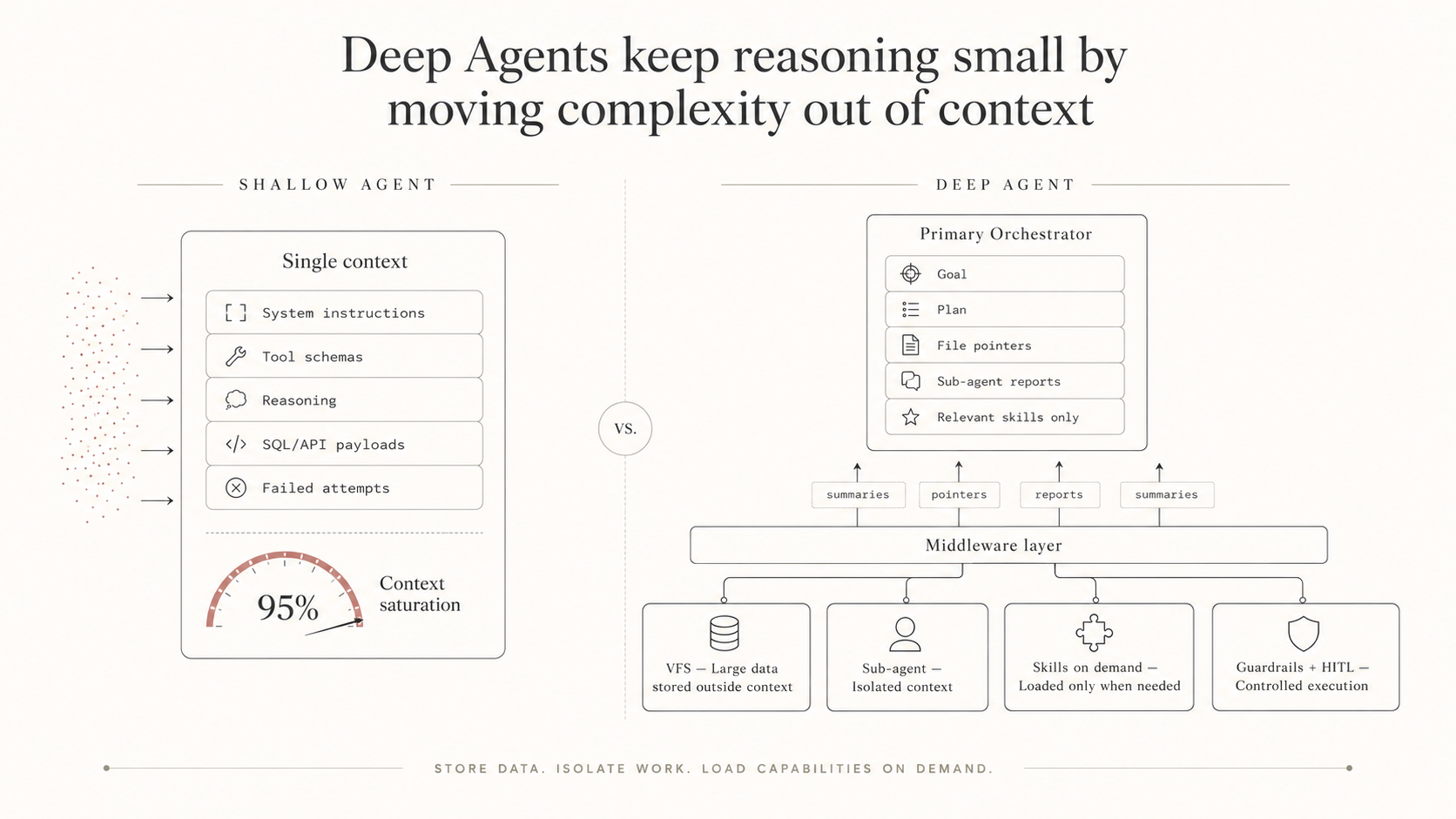
In a standard agentic implementation, the orchestration logic is often monolithic. Every action, tool output, and intermediate thought is appended to a single sequential thread. The total token footprint of an active agent is the aggregate of its system instructions, the injected tool schemas, the model's generated reasoning steps, and the external tool outputs.
In an enterprise environment, this architecture rapidly collapses. A single SQL query or API call can return thousands of rows, causing the external output portion of the context to grow uncontrollably. When the active context approaches the model's limit, the attention mechanism dilutes. The model begins to hallucinate parameters, forgets its initial system instructions, and fails to plan the next logical steps.
Payload Eviction via the Virtual File System (VFS)
To bound the growth of tool outputs, Deep Agents introduces a Virtual File System (VFS) abstracted and orchestrated by a middleware stack. This architecture strictly decouples data storage from the active reasoning context.
When an external tool returns a massive payload, the FilesystemMiddleware acts as an interception layer. By default, any output exceeding 20,000 tokens is intercepted before it reaches the LLM. The framework silently offloads the raw data into a storage layer defined by the BackendProtocol (such as a StoreBackend backed by PostgreSQL).
The LLM receives only a file pointer and a short, 10-line text preview. To access the rest of the data, the agent must explicitly use standard Unix-like tools (grep, read_file) provided in its schema. This mechanism forces the model to treat data as an external resource rather than internal memory, significantly reducing the passive token load.
Context Isolation Through Asynchronous Delegation
While the VFS mitigates data overload, complex workflows still generate computational noise. Tasks like debugging code or iterating on database queries require multiple iterative execution cycles, which fill the context with failed attempts and redundant reasoning steps.
Deep Agents handles this through context isolation enforced by the SubAgentMiddleware. The framework restricts the primary agent to a project management role. When a complex task is identified, the primary agent uses a specific tool to spawn a sub-agent.
This sub-agent is instantiated as an independent LangGraph state graph. It starts with a clean memory state and a highly specialized system prompt. It executes its own tool loop in total isolation. Once the task is completed, the sub-agent terminates and returns a structured JSON report to the orchestrator. This architectural boundary ensures that the orchestrator's context remains clean and solely focused on high-level objectives.
Progressive Disclosure and Dynamic Tool Allocation
Enterprise environments expose a vast array of internal tools via protocols like the Model Context Protocol (MCP). However, systematically injecting an exhaustive list of tool schemas into the system prompt saturates the context before the agent even begins its task.
Deep Agents mitigates this via progressive disclosure. Instead of loading full behavioral scripts, the framework parses only the frontmatter of Markdown-based skill files (SKILL.md) at initialization. The LLM sees only the name and a short description of the available skills. If the model determines a specific skill is required for its current planning phase, the framework dynamically loads the full instructions into the context.
Performance analyses demonstrate that disabling default system tools and enforcing this progressive disclosure reduces the initial token footprint of the agent by 65%. This indicates that dynamic schema injection is a mandatory requirement for scaling multi-tool enterprise agents without degrading initial planning capabilities.
Execution Guardrails and Declarative Access Control
Deploying agents in production requires strict boundaries on what data they can read or modify. Relying on an LLM to follow prompt-based guidelines is ineffective at scale. Deep Agents addresses this by enforcing access control at the resource layer through a declarative FilesystemPermissions engine.
The engine evaluates access rules. A rule specifies the target operations, the file paths (using glob patterns), and the resolution mode (allow, deny, or interrupt).
Crucially, this system uses an opt-out model: if an agent's action does not match any specific rule, it is allowed by default. Therefore, an enterprise configuration must always conclude with a catch-all deny rule mapping all root paths to prevent unintended access to broader system resources.
For highly sensitive changes, such as dropping a database table or modifying a production configuration, developers can set the mode to interrupt. This leverages LangGraph's checkpointing system to pause execution, allowing a Human-in-the-Loop to review the LLM's generated arguments before the state graph is allowed to proceed.
Architectural Trade-offs and Optimization Paths
Despite these structural improvements, the framework presents several technical trade-offs that highlight clear paths for future optimization in enterprise deployment:
-
Context Summarization Trade-offs:
When the context reaches 85% capacity, the
SummarizationMiddlewareinvokes a smaller LLM to compress historical messages. Optimizing this process requires finding new state management patterns to ensure subtle, long-term data crucial for later workflow stages is not permanently deleted during routine compression. - Distributed Token Budgeting: While the framework efficiently delegates tasks to parallel sub-agents, there is currently no native middleware to enforce a strict financial token budget across a distributed tree of concurrent agents.
Conclusion
The integration of autonomous agents into the enterprise has reached a highly promising milestone. We are successfully moving past the limitations of early, fragile tool-calling scripts. Frameworks like Deep Agents prove that by applying proven software architecture principles through agent harnesses, organizations can overcome data overload and build AI systems that reliably scale to solve real-world challenges.
By leveraging virtual file systems for payload eviction and enforcing context isolation via sub-agents, the framework successfully shields the orchestrator's reasoning capabilities from computational noise. This ensures stable, reliable performance even in highly complex workflows.